
Home / Shop
RX-331 HF DSP Receiver


- Description
- Specifications
- Customer Reviews (0)
The TEN-TEC RX-331 is a multi-mode HF receiver operating fron 5kHz to 30 MHz, fully synthesized and utilizing state-of-the-art Digital Signal Processing. DSP technology brings the performance and repeatability of expensive military grade communications receivers into the more economic range of commercial receivers.
The design flexibility of DSP provides 57 standard selectivity choices from 100 Hz to 16 kHz. It is also practical to customize filter bandwidths, shape factors and time delays to match unique customer requirements.
The RX-331 is designed specifically for remote controlled applications. Multi-drop RS-232 interface permits simultaneous operation of multiple receivers on a single network at baud rates from 200 to 19,200. Receiver may be controlled by either internal or external frequency reference and an optional high stability internal reference is available.
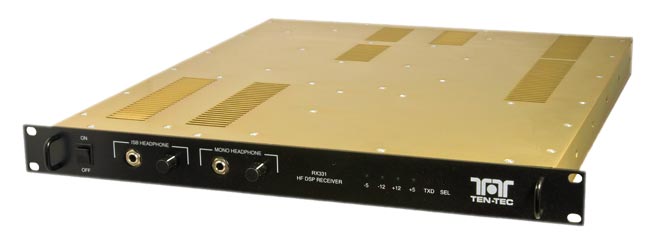
This receiver is a compact, rack mount unit only 1 3/4" high - ideal when available rack space is a at a premium. Power consumption is a nominal 30 watts which can provide a measured advantage when comparing recurring system costs. All connections are arranged on rear panel. Front panel provides ON/OFF switch, headphone jacks with independent volume controls, serial port status indicators and power supply indicators.
Built-in Test (BITE) allows quick field verification of major subsystems. Built-in software provides a "field test" mode to allow complete receiver operation from a simple terminal without need of customer's complete control system.
Frequency Coverage
50kHz - 30 MHz at typical sensitivity. Tunable down to 0 MHz with degraded performance.
Mode
USB, LSB, ISB, CW, AM, Synchronous AM, FM; all standard
Tuning Resolution
1 Hz steps.
Frequency Stability
+/- 1 PPM per degree C within operating range 0-50 degrees C using internal reference. Optional TCVCXO provides +/- 1 PPM over entire operating range.
Accuracy
All internal oscillators are locked to either internal or external frequency standard. The internal reference is adjustable by a continuously variable trimmer to allow calibration to any desired accuracy.
External Frequency Reference
1,2,5, or 10 MHz (+/- 1 PPM, 200 mv p-p into high impedance load). Receiver automatically switches to this reference upon application, at power up or after any serial link activity.
Spurious Responses
All spurious less than -119 dBm equivalent input - preamp on.
Image Rejection
90 dB typical, 80dB minimum
BFO
Tunable in CW mode only, +/- 8 kHz. Tuning in 10 Hz steps with a tuning accuracy of +/- 10 Hz of desired frequency setting. Fixed frequency in SSB/ISB (455 kHz), disabled in AM and FM.
Synthesizer Lock Time
10 msec typical
Antenna Input
50 ohm, unbalanced, BNC connector. 2.5:1 VSWR max @ receiver's tuned frequency.
Selectivity
57 bandwidths selectable from .1 kHz - 16.0 kHz. Shape factor 1.5:1 or better. (6 to 60 dB) bandwidth is fixed at 3.2 kHz in ISB mode, and at 6kHz in SAM mode. Minimum bandwidth is 600 Hz in FM mode.
Group Delay
no more than .1 ms variation over passband of 300 Hz to 3050 Hz.
Ultimate Rejection
70 dB minimum regardless of filter selected
Lo Phase Noise
-120 dBc/Hz @ 20 kHz offset typical, -100 dBc/Hz maximum
IF Rejection
90 dB typical, 80 dB minimum
Memories
100 memory store and recall
Operating Temperature Range
0 - 50 degrees C @ full specification. -10 to 60 degrees C with degraded performance.